
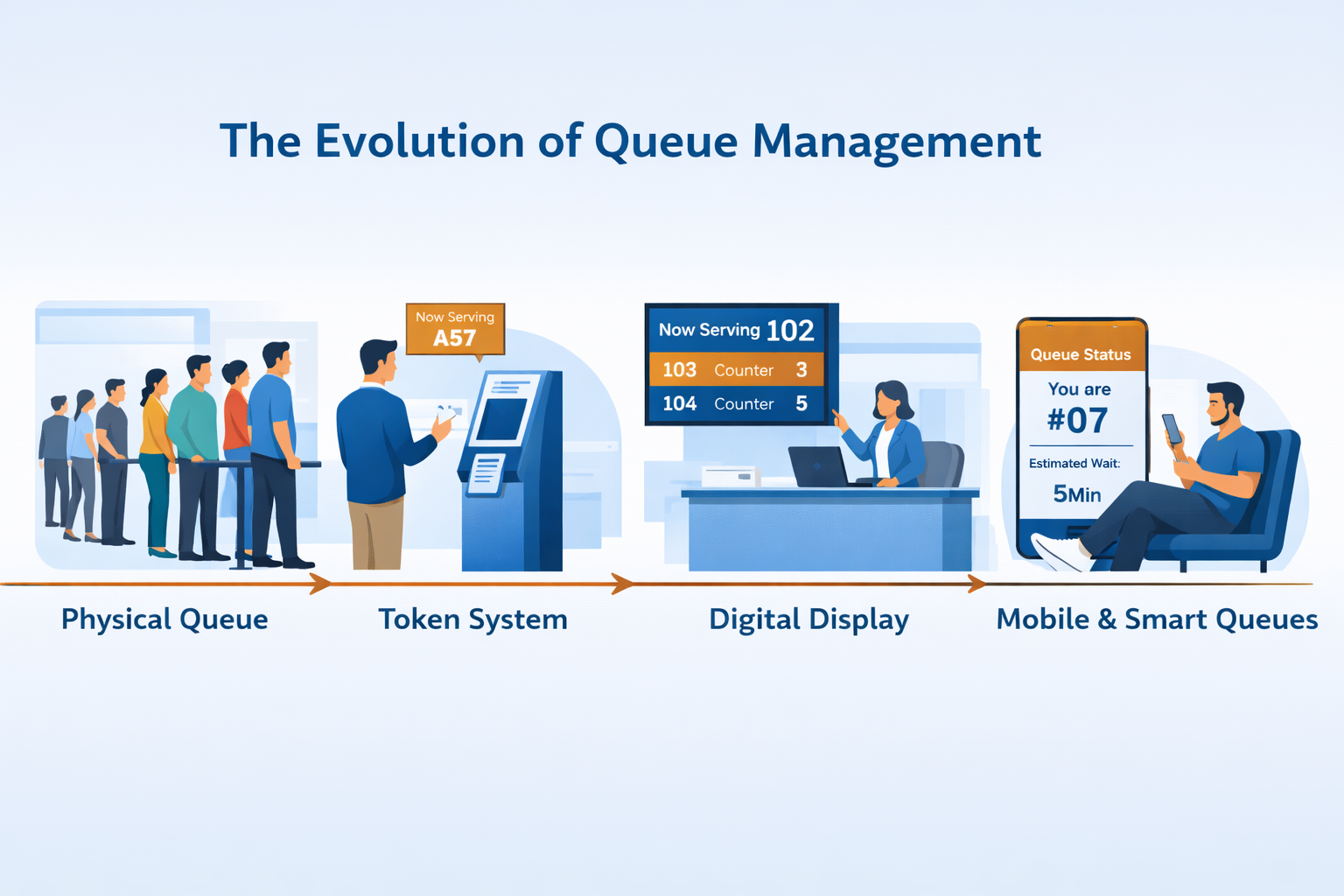
Queues have existed as long as organized services have. Whether waiting at hospitals, banks, government offices, or retail service counters, people have always had to wait for their turn. However, the way organizations manage queues has evolved significantly over time.
What began as simple physical lines has transformed into sophisticated digital systems designed to improve operational efficiency and customer experience. Today, queue management is no longer just about controlling lines—it is about managing service flow, optimizing resources, and delivering a better waiting experience.
Understanding this evolution helps organizations appreciate why modern queue management systems are becoming essential for service-driven environments.
The Early Days: Physical Lines and Manual Coordination
In the early stages of service operations, queues were managed entirely through physical lines. Customers or patients would simply stand in line and wait for the next available service representative.
While this approach was straightforward, it created several challenges. Long lines often caused congestion, confusion, and frustration. Customers had little visibility into how long they would need to wait, and staff had limited control over the flow of people.
Manual coordination also placed additional pressure on employees, who had to manage both the service process and the queue itself. This lack of structure often led to inefficiencies and operational losses, particularly during peak hours when demand increased rapidly—something explored further in our guide on the hidden cost of poor queue management in high-volume service environments.
As service environments grew more complex and customer expectations increased, organizations began exploring more structured approaches to queue management.
The Introduction of Token-Based Systems
The next stage in the evolution of queue management introduced token or ticket systems. Customers would receive a numbered ticket and wait until their number was called.
This method helped eliminate the need for customers to physically stand in line. Instead, they could sit comfortably while waiting for their turn. Token systems also created a more organized service environment by establishing a clear order for service.
However, these systems still relied heavily on manual processes. Staff members often had to call numbers manually or manage token dispensers, which limited efficiency. Additionally, customers still lacked visibility into how long they would have to wait.
While token systems improved the physical waiting experience, they did not fully solve the challenges associated with unpredictable wait times and operational coordination.
The Shift Toward Digital Queue Management
As technology advanced, organizations began adopting digital queue management systems. These systems replaced manual tokens with electronic registration, digital displays, and automated queue tracking.
Digital queues introduced several important improvements. Customers could check in electronically, reducing the need for manual registration. Service counters could call the next customer automatically, ensuring a more consistent flow.
Digital displays also improved communication by showing queue numbers and directing customers to the appropriate service point. This transparency reduced confusion and helped customers feel more informed during the waiting process.
For service organizations, digital systems also provided better control over queue flow, allowing staff to manage service demand more effectively.
Real-Time Visibility and Data-Driven Operations
Modern queue management systems have evolved beyond simply organizing lines. Today, they provide real-time insights that help organizations optimize operations.
Managers can monitor queue length, waiting times, and service performance through dashboards and analytics tools. These insights allow organizations to identify bottlenecks, adjust staffing levels, and improve service flow throughout the day.
Operational visibility also enables organizations to respond quickly to demand fluctuations. If a particular service counter becomes overwhelmed, resources can be reallocated to maintain balance across the system.
This data-driven approach transforms queue management from a reactive process into a strategic operational tool.
Mobile Integration and Contactless Experiences
Another major milestone in the evolution of queue management is mobile integration. Many modern systems allow customers to join queues through mobile devices or receive updates about their waiting status remotely.
This capability reduces congestion in waiting areas and provides customers with greater flexibility. Instead of standing in line, they can monitor their position in the queue while completing other tasks.
Mobile-enabled queue systems also support contactless service environments, which have become increasingly important in recent years. By minimizing physical interactions during the registration and waiting process, organizations can create safer and more efficient service experiences.
Queue Management as a Customer Experience Strategy
Today, queue management is no longer viewed solely as an operational function. It has become a critical component of customer experience strategy.
Waiting is often one of the first interactions customers have with a service organization, and in many industries, it has become a key performance indicator, as discussed in our article on why waiting time is the new customer experience metric. If the waiting experience is chaotic or frustrating, it can negatively affect the perception of the entire service journey.
Modern queue management systems focus on making waiting more transparent, predictable, and comfortable. By providing clear communication, real-time updates, and structured service flow, organizations can significantly improve how customers experience waiting.
This shift reflects a broader understanding that operational efficiency and customer experience are closely connected.
The Future of Queue Management
The evolution of queue management is far from complete. Emerging technologies such as artificial intelligence, predictive analytics, and automation are expected to further transform how organizations manage service demand.
Future systems may anticipate peak demand periods, recommend staffing adjustments, and dynamically allocate service resources. These capabilities will allow organizations to minimize waiting times while maximizing service efficiency.
As customer expectations continue to rise, queue management will play an increasingly important role in delivering seamless service experiences.

Transform Waiting with Modern Queue Management
Queues will always exist in service environments where demand fluctuates. The key difference lies in how effectively they are managed.
Modern queue management solutions help organizations move beyond simple line control toward smarter service flow management. In fact, many organizations now realize that queue management is no longer optional for delivering consistent service experiences. By combining digital check-ins, real-time visibility, and operational insights, these systems enable organizations to create more efficient and predictable service experiences.
ZUNA QMS is designed to help service organizations streamline queues, reduce waiting frustration, and improve operational efficiency. With intelligent queue coordination and real-time monitoring, ZunaQMS turns waiting into a structured and manageable part of the service journey.
Book an appointment today to see how ZunaQMS can help transform queue management in your organization.