
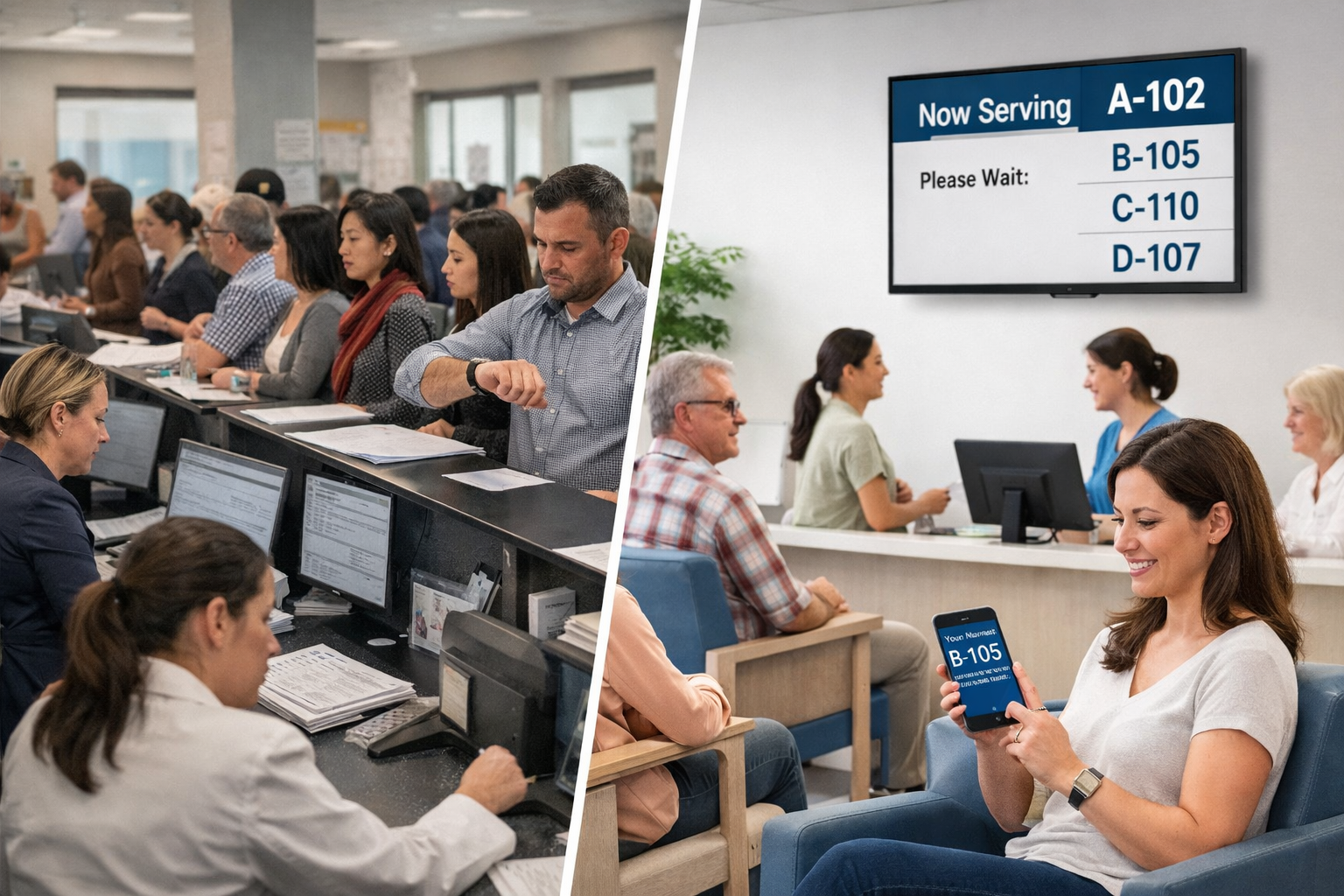
Branch banking hasn’t disappeared, even as digital banking grows — most customers still want a physical location for certain transactions and conversations. But that means the in-branch experience still matters, and long teller lines remain one of the fastest ways to lose a customer’s confidence, if not the customer entirely.
The instinct when lines get long is to hire more staff. But for most banks and credit unions, the real problem isn’t headcount — it’s visibility and routing. Here’s how modern queue management system addresses branch waits times directly, without adding a single teller.
Why Branch Wait Times Are a Retention Problem, Not Just a Convenience Issue
Long support and branch wait times are directly linked to customer churn — waits exceeding 10 minutes are associated with a meaningfully higher likelihood that a customer leaves the bank altogether. On the other side of that equation, customers who use appointment scheduling tools to plan their branch visit are notably more likely to return for future interactions. The data points in the same direction as what we found across every service industry we looked at: giving customers control over how they wait matters as much as how long they actually wait.
Where Branch Queues Actually Break Down
Most branch wait-time problems come from a small set of recurring issues:
- Undifferentiated lines. A customer who needs a 30-second balance inquiry waits behind someone opening a new account, because both are in the same physical line.
- No visibility into wait time. Customers walk in, take a number, and have no idea if they’re facing a 5-minute or 25-minute wait — so they either leave or grow frustrated while waiting.
- Uneven staff allocation. One teller station backs up while another sits idle, because there’s no real-time signal telling a manager to shift someone over.
- No pre-visit scheduling option. Every visit is a walk-in, even for transactions customers would happily book ahead of time if given the option.
How Smart Queue Management Solves Each of These
Skill-based routing separates transaction types
Instead of one undifferentiated line, customers are routed to the right queue based on what they need — quick transactions, new account services, loan consultations — so a simple request never gets stuck behind a complex one.
Real-time wait estimates reduce walkouts
When customers can see an accurate estimate (and check it from their phone via virtual queuing instead of standing in the lobby), they’re far less likely to leave before being served.
Live dashboards let managers reallocate staff instantly
Rather than discovering a bottleneck after customers are already annoyed, branch managers can see queue buildup in real time and shift staff to the station that needs it — the same staff-utilization principle that applies across every service industry, applied specifically to teller and specialist scheduling.
Appointment scheduling handles plannable visits ahead of time
Loan consultations, account openings, and other longer transactions can be scheduled in advance, so they don’t compete with walk-in traffic for the same staff and space at the same time.
Compliance and Security Considerations for Banks
Banking queue management carries the same data-handling responsibility as any customer-facing financial system. When evaluating a platform, confirm it supports the compliance and security standards your institution is already held to — data encryption, access controls, and audit-ready reporting — the same category of requirement healthcare organizations evaluate for HIPAA, applied to financial data instead of medical records.
Multi-Branch Considerations
For banks and credit unions with more than one branch, centralized queue management matters as much as the in-branch experience itself. A single dashboard showing wait times, staffing, and volume across every branch lets regional managers spot patterns — a branch that’s consistently understaffed at certain hours, or one location outperforming others on wait time — and make staffing decisions based on real, comparable data rather than anecdotal reports from each branch manager individually.
Frequently Asked Questions
How does the queue management system reduce bank branch wait times?
By routing customers to the right line based on transaction type, giving real-time wait estimates, and letting managers reallocate staff to bottlenecks as they form, rather than reacting after a line has already backed up.
Does a queue management system require adding staff?
No. Most wait-time improvements come from better routing and staff allocation with the team already in place, not from hiring additional tellers.
Can appointment scheduling work alongside walk-in banking?
Yes. Modern queue management systems manage scheduled appointments and walk-in traffic from the same real-time queue, so both are visible to staff at once.
See How ZunaQMS Fits Your Branch Network
Curious how a modern queue management system could reduce wait times across your branches? Explore our banking and financial services solutions or book a demo to see how ZunaQMS fits your specific locations and staffing model.